CPG Sales Strategy: How Managers Coach Reps in the Field
A CPG sales strategy is won or lost at the shelf. How field sales managers turn store-visit photos and notes into weekly coaching that reps can use.

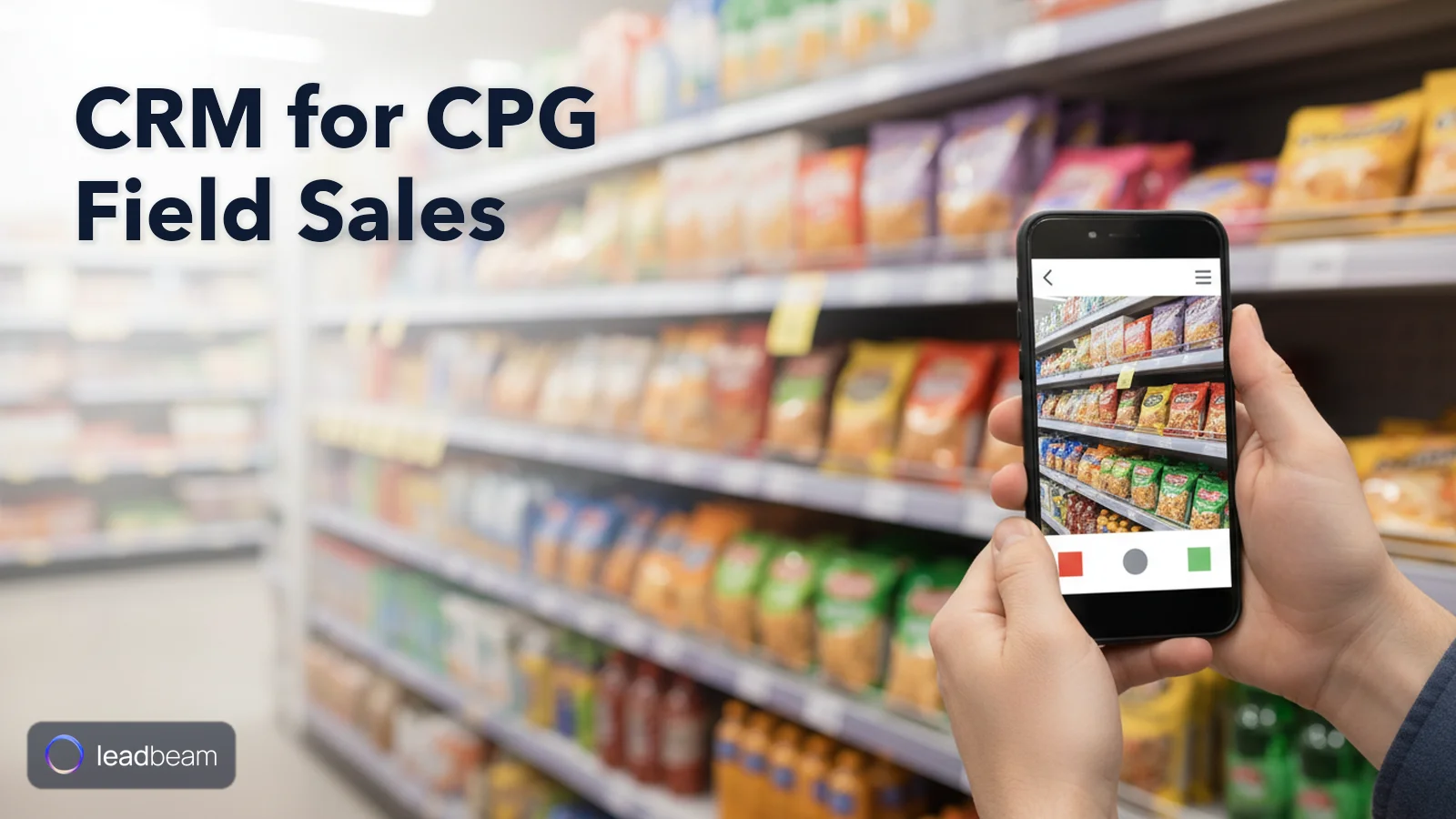
Picture a rep in a grocery parking lot at 4:40 on a Thursday.
On their phone is a photo of an empty endcap. Your brand funded that display for this week's promotion. Three people need to see the photo: the distributor who should have delivered the cases, the broker who covers the reset, and the key account manager who negotiated the promo with the chain buyer.
None of them will see it. The CRM has a field for the chain's name and a notes box.
A CPG CRM is the system a consumer packaged goods brand uses to run its retail field work. It tracks every store as its own record, tied to the chain buyer, broker, and distributor behind it, with the shelf photos and notes from each visit.
That's the gap a CPG CRM has to close, and the clock is running: 72% of retailers say they're ready to deploy in-store robots to scan shelves, per a 2025 IHL Group and Brain Corp survey. Soon the chain will have its own record of your shelf. Yours has to come from a photo and a short voice note in that parking lot, because reps won't type.
Most CRMs assume one shape: an account, its contacts, and your deals. A CPG brand doesn't fit it. The party that pays you, the party that decides what's on the shelf, and the place your rep spends the day are three separate records.
Vertical vendors already model it this way. Salesforce's consumer goods data model gives each physical store its own RetailStore record linked to a business account, with a separate task object for planogram, inventory, and promotion checks. Whatever CPG sales software you pick should treat the store as a first-class record.
If that Thursday rep covers 40 doors of one chain, a generic CRM rolls every visit into one account. Finding which stores lost the endcap means reading 40 sets of notes.
Each has a detail generic tools miss:
The chain: set targets by store group. A chain-wide compliance average hides the few doors dragging it down, which are the doors that need a visit. Salesforce's model maps store groups to targets it defines as the expected compliance values for each check. Ask any vendor where store-group targets live.
The store: keep the authorized item list on it. Once the store record holds what's authorized, voids stop being a guess. Anything authorized but missing from the shelf photo is a void the rep can pitch today.
The broker: your broker may see more of your stores than you do. Advantage Solutions alone serves over 4,000 consumer brands across roughly 85,000 store locations. If a broker merchandises some of your doors, their visit notes belong on your store record. Keep a coverage map so two people don't call the same buyer while nobody calls the store.
The distributor: map it by door, not by region. UNFI reports buying from nearly 10,000 suppliers and serving more than 30,000 customer locations in its fiscal 2025 annual report. A food and beverage CRM that can't name the distributor contact for each door sends out-of-stocks nowhere.
The visit: evidence, then commitments. Photos, checks completed, voids found, promo status, and what the rep promised to fix.
Promotions belong on the store, not just the chain. In one Circana example, promotions moved about 60% of a mid-sized frozen entrée brand's volume, and roughly 40% of those promoted sales were subsidized, meaning shoppers would have bought anyway. A promo can run perfectly and still lose money, so the CRM needs to show whether it ran before anyone blames the field. Promo misses often start upstream, when the terms the key account manager negotiated never reach the rep standing at the shelf.
NielsenIQ puts the initial slotting fee for a new product at around $250 to $1,000 per item per store, so an empty facing during a funded promotion wastes money twice: the placement and the promo.
Gary Schneider of Bay Food Brokerage writes in Grocery Dive that weak early sales on a new item can reflect execution problems rather than a lack of demand, and that he has seen new brands fail at some retailers within six months. That argues for front-loading visits on new items.
In the same IHL Group and Brain Corp survey, only about a quarter of major U.S. retailers met basic shelf-accuracy benchmarks for on-shelf availability, planogram compliance, and promotional execution. In the same study, 67% said inventory inaccuracy caused daily or weekly friction with consumer brands.
A rep who arrives with proof and fixes the shelf solves the store's problem too. Once those robots arrive, a brand without a clean visit history ends up arguing with the retailer's data.
Three things make a visit record worth keeping:
Back in that parking lot, the photo only helps if it reaches the store record in seconds. The rep takes the photo, speaks a short note on the way to the car, and the void, the distributor ticket, and the promo miss land on the right records without typing. For the full in-store method, see the retail store audit checklist and how teams run mobile retail execution.
A shelf problem rarely belongs to the person who found it. Schneider makes the same point: manufacturers, brokers, distributors, retailer teams and individual stores may all play a role, which makes it easy for execution issues to fall into gaps between organizations.
Routing fails when the visit note names the problem but not the owner. Fix it at the shelf with this map:
The issues that never close sit between two owners. The store says the cases never arrived; the distributor says they were delivered. A timestamped shelf photo on the store record ends that argument faster than any email.
A useful CPG CRM logs the issue once, routes it to that owner with the photo, and shows whether anyone closed it. Your key account manager then walks into the next line review with store-level evidence, not anecdotes.
That evidence matters more each year. Almost half of grocery retail executives in a Deloitte survey see national-brand CPG partnerships becoming less important over time, and store brands grew dollar sales 3.3% in 2025 against 1.2% for national brands, according to PLMA's Circana data. When the chain's own label is gaining, a brand that can't show store-level execution walks into the line review with a weak hand. For distributor-heavy routes, see how FMCG distribution software splits the work.
Reps hand off too. BLS projects about 123,400 openings a year for wholesale and manufacturing sales representatives, most from replacing people who change jobs or retire. If store history lives in a notebook, every store starts over.
Reps can start these habits this week, in any CRM:
Public, CPG-specific numbers on visits per day are scarce. One we could verify: a merchandising agency's posting for a Nestlé seasonal confectionery program in Canada asks for a minimum of 4 stores per day, each visit lasting up to 90 minutes. Use it as one reference point and set it beside your own numbers.
Before any CPG CRM demo, pull these from your last four weeks:
Stores visited per rep per day, from the CRM, mileage logs, or calendars.
Minutes in store versus minutes driving, from five full days per rep.
Share of visits with a shelf photo attached.
Open store issues by owner, and how many closed within a week.
Time from leaving the store to the visit being logged.
Watch the last one. If it's measured in days, managers coach from memory and buyers hear about last week's shelf. Our piece on why field reps don't log covers how that happens.
The options fall into four overlapping categories. Judge any CRM for consumer goods on one question: does it hold store, broker, and distributor records without custom work?
Generic sales CRM. Built around accounts, contacts, and deals. It handles chain-level selling, but stores, brokers, and distributors usually need custom objects.
Industry-cloud CRM. A consumer goods edition of a larger platform, with store and visit records built in. Ask how much configuration it needs before reps can use it.
Field-sales or mobile CRM. Built for reps on the road, with visit capture at the center. Check whether it models stores separately from accounts; our guides to the best CRM for field sales and the best mobile CRM for sales reps cover the general criteria.
Retail execution platform. Built around the store visit: audits, photos, and compliance. It often sits beside a CRM instead of replacing it, and our retail execution software guide covers the vendor types.
Whether a vendor calls itself an FMCG CRM or a retail execution platform, load one real store and walk it through the system live.
Pick a store with a known problem, such as a void or a promotion that didn't run. Then ask to see:
A tool that needs custom development for half of that list will cost more than the license suggests. For why the shelf decides the outcome, see what retail execution is.
The right consumer goods sales software holds your chain, store, broker, and distributor records the way they work in the aisle, and turns each shelf photo into the first step of a fix. To see how voice notes and shelf photos become structured store records, Leadbeam's Pulse page shows the flow.


Leadbeam Blog
Discover tips, strategies, and success stories to empower your field sales team and drive results.