Retail Store Audit: The 12-Minute Checklist That Pays
A retail store audit should take about 12 minutes and change what the shelf looks like. Here is the walk-order checklist and the method behind it.

The plan says eye level. The shelf says bottom rack.
You won't hear about it for six weeks, and by then that store's reorder has already shrunk. Planogram compliance is the job of closing that gap, and it fits into five checks and a photo. Four minutes at the set is the working target we hold field teams to, not a figure anyone has benchmarked. Most programs never collect the benefit, because what they gather is a claim nobody can check.
Somebody measured the gap. Research published in November 2025 surveyed executives at 200-plus large US retailers and found fewer than one in four reach 80% accuracy on three shelf metrics: on-shelf availability, planogram compliance, and promotional execution. Half reported lost sales from execution failures. Read the sponsor before you quote it: the study is IHL Group's, published with Brain Corp, which sells in-store robots.
Inside large DSD organizations, the same Tuesday repeats. Stop six of eleven, a suburban grocery, and your rep finds the 12-pack set sitting two shelves under the drawing the retailer signed. They move what fits, drive off, and nothing about that shelf reaches anyone.
Six weeks later a category manager is looking at flat numbers from a store that reads as compliant in every report they have. We'll come back to that store. Designing the set is a different job with a different buyer; what a planogram is and who builds it covers that side.
Run them in this order, because that's the order they cost you money. Forward this section to your reps.
Presence. Is every authorized SKU on the shelf? A missing item is either a void, where the store never ordered it, or an out-of-stock, where the store ordered it and let it run dry. They look identical in the aisle and need opposite responses: one is a sell, the other is a hunt for a stocker.
Position. Did the set land where the plan put it, at the height the plan bought? You paid for eye level because eye level sells. Two shelves down, the same SKU quietly turns into a different product.
Facings. Does your share of shelf match what the retailer granted you? Facings migrate. Picture the beverage aisle at 7 a.m. on a Monday. A competitor's rep is squaring up their own block after weekend selldown, and your single-facing lemon-lime at the end of the bay is the easiest thing in the set to absorb. Nobody logs it. You see it when the reorder comes in light.
Price and POS material. Is the shelf tag right, and did the promotion get signed? Say you funded a 2-for on 12-packs and the store never changed the tag. Shoppers pay the everyday price, the volume lift never happens, and the discount still lands on your invoice. You paid for the promotion twice.
Secondary display. Did the endcap or floor stack you bought get built, and is it still standing in week three? Ask the second half out loud. A display that goes up on day one comes down the week the store wants that footprint back, while your contract still says four weeks.
The rest of the visit runs longer; the full store-visit checklist covers it.
Almost every planogram compliance number in this business is self-reported by the person being measured. A rep walks the set, taps "compliant," and drives on. That tap becomes the record, and the record is all anyone downstream ever sees. Six weeks later a category manager plans against it and a trade analyst reconciles spend to it, and neither of them can tell whether the shelf was studied or glanced at. The problem isn't rep honesty. It's that a record carrying no evidence can't be checked, which means it also can't be corrected.
Even an honest tap has a shelf life, and decay moves in predictable patterns.
Night crews restock from the backroom in whatever order the cart came off the truck. A competitor's rep fills the hole in your set with their own facings. Then a reset lands and the store improvises around a fixture that doesn't match anyone's drawing at HQ. A store that measured clean on the 3rd can be off by the 17th without a single person doing anything wrong.
Now put money on it. CPG companies commit roughly 20% of revenue to trade promotions, and 72% of US promotions never earn it back. That second figure is Nielsen's, from 2016; McKinsey is the one carrying it. Part of the shortfall is promotion design. Part of it is a display that never got built at a store that billed you anyway.
A compliance program that can't separate those two puts your commercial team in a quarterly argument about promotion strategy when the failure was execution. That argument repeats until somebody walks in with a photograph.
A Salesforce survey fielded in 2022 put reps at about 28% of the week selling, and that's general B2B; DSD routes give up more of the day to windshield time. Against that math, a second app for compliance is the first thing to go, for the same reason reps quietly stop logging in the CRM once the novelty wears off.
Verification has to ride on something your rep already does. Here's the loop that survives a real route.
The right plan reaches the right stop. Store-specific version, on the phone, before your rep opens the door. A shared drive of PDFs named after regions breaks first, because the rep at stop nine will not go hunting for the correct file.
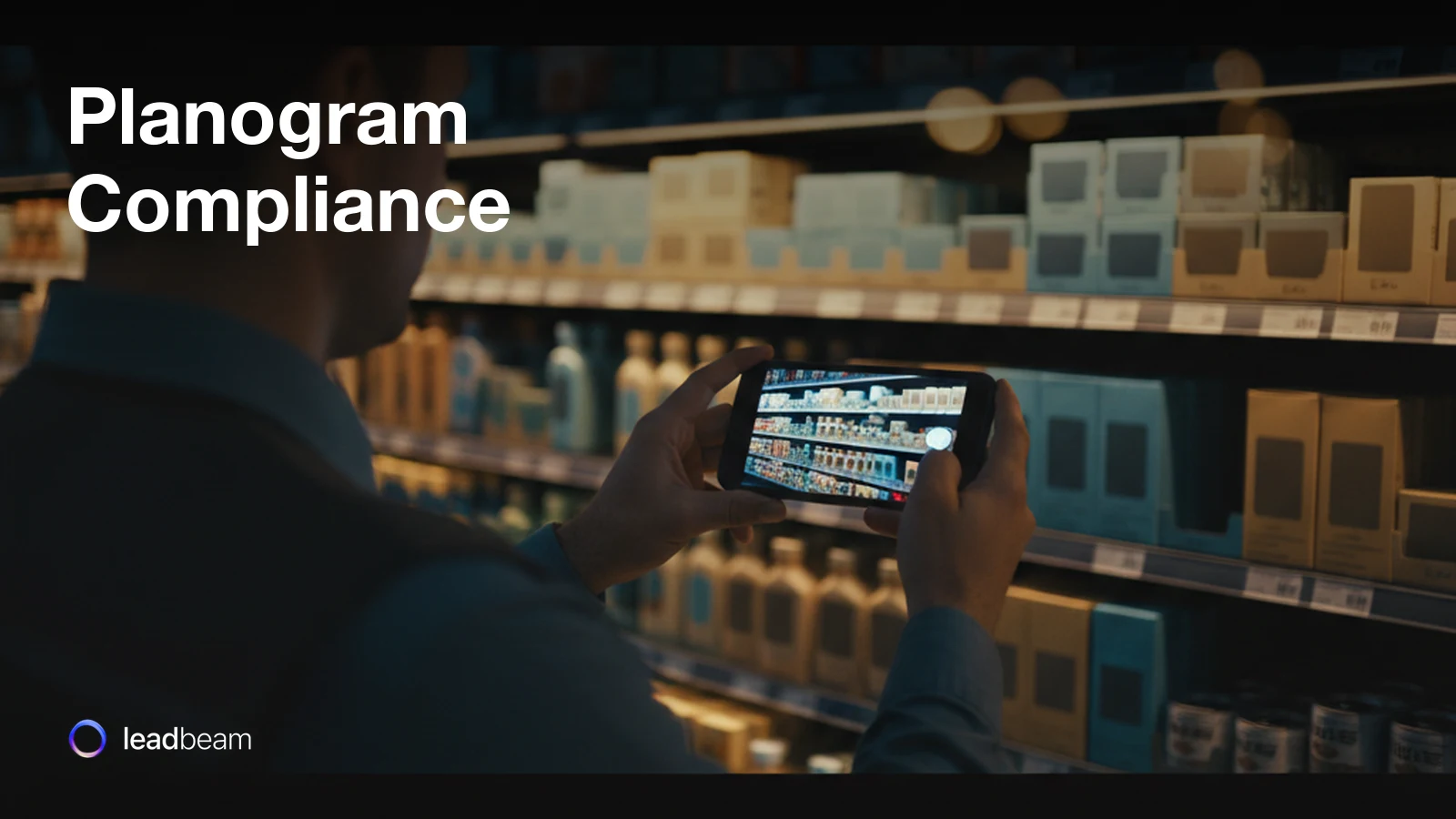
The rep photographs the set they were going to inspect anyway. No rep has ever counted a full bay into a form field, and none will start this quarter.
Software compares that photo against that store's plan. This is a documented category approach rather than a novelty. A system published in Sensors in 2015 already matched approved planograms against pictures from stores and returned the differences between the two. What has moved since is accuracy, and how much of it runs on a phone instead of a fixed camera.
The output reads as actions, not a score. Something closer to move the 12-packs up one shelf, core SKU running two facings light, endcap not built than a compliance percentage. A score is a management artifact and an action list is a task, so pick based on who reads it while standing at the shelf.
The reorder gets written before your rep leaves the aisle. Your rep arrives holding the authorized-but-never-ordered SKUs for that store, the shelf check confirms they're still missing, and the order line goes in while the evidence is still in front of them.
Only step two belongs to your rep, and it's the one step a capture layer already covers. Pulse exists to turn what a rep says and shoots into CRM records without a form in the way. That's also how the reasoning behind a flag survives the drive to stop seven. Steps three through five are the ones to make a vendor prove in a pilot, against your own planogram files and your own lookalike SKUs, before you sign anything. Ask what the software does when it can't read a bay. The wider store call is covered in our guide to running the visit from a phone.
Photo comparison earns its keep. It also has edges, and the academic literature names them more honestly than most vendors will. A 2020 review in Computational Intelligence and Neuroscience names lighting, backgrounds, and occlusion as the environmental factors that degrade product identification, and singles out two flavors of the same brand as a case even shoppers get wrong. All of it shows up in a beverage aisle every week:
Glass and glare. Cooler doors bounce the aisle back into the lens, and chilled beverage is exactly where planogram discipline pays.
Long sets. A twelve-foot bay takes several frames, and the frames have to overlap, or the counts go wrong at the seams.
Lookalike variants. Flavor extensions in near-identical packaging are the hardest call in the aisle. Narrow facings make it harder.
Version drift. The file goes wrong more often than the camera does. A remodeled suburban grocery drops your set from eight feet to four, the new drawing never reaches HQ, and photos keep getting scored against the old one. Every audit at that store now reads as a facing shortfall no rep can fix, and your reps stop believing the flags.
What a photo can't see. An empty facing doesn't tell you whether six cases are sitting in the backroom. That answer decides whether your rep writes an order or goes to find a stocker. Close it wrong and the store takes a delivery it didn't need, the cases behind the endcap age out, and the next reorder drops for a reason nobody traces to the audit.
The rule that holds: the photo settles what is on the shelf, and the rep settles why. A program that keeps only the first half produces confident, wrong planogram compliance data, which is worse than a blank field. A blank field gets investigated. A wrong read sends trade dollars to the wrong stores, then defends the decision with a screenshot.
Start with the retailer. Walk into a category review with dated photographs and "we think execution slipped" stops being an opinion the buyer is free to wave off. It becomes a record with a date on it, and the meeting turns from an argument about whether the shelf drifted into a conversation about who fixes it. That's the version of that meeting where you get the space back.
Then there's what your own side is allowed to do with the number. An unverified compliance score has one use, and it's grading reps. Nobody builds a week around a figure they suspect, and no VP carries one into a line review. A photo-backed number can take weight, so it can sit beside order velocity and open voids and help decide which doors get a stop. A store that has drifted three weeks running earns the visit; a store holding steady keeps its cadence slot. A fixed calendar can't make that call, because a calendar doesn't know what the shelf looks like.
The last change settles an argument your commercial team has been having for years. When a promotion underperforms, the room splits between the people who think the offer was wrong and the people who think the stores never built it, and both sides are guessing. A month of photographed sets ends that split on evidence instead of seniority.
None of it comes from the camera. The camera makes the discipline auditable, which is where most retail execution programs stall: the instrument gets bought and the standard never gets set. Teams running DSD routes hit that wall first, and if you're shortlisting planogram compliance software, our breakdown of retail execution software covers what to ask a vendor.
Four moves worth making before you buy anything.
Then hand your reps the five checks and nothing else. Presence, position, facings, price, display. Four minutes and a photo. That's the part that belongs to the person in the aisle, and it sticks after one ride-along.
Now go back to that Tuesday. Same rep, same stop six, same 12-pack set two shelves low. This time the plan for that store is on the screen before the door opens, the photo takes eight seconds, and the fix leaves the store as a record instead of a memory. Six weeks later your category manager can point at the exact week that store started drifting.
Expect something uncomfortable in the first month: the stores you assumed were problems are worse than the last report said. Start with one territory and run the five checks with a photo on every record. Pulse is one way to get the photo and the spoken note into a record without a form; a phone camera and a shared folder is another, and it will tell you the same thing in month one. Then put that month against what your reports have been claiming all year. Where the two disagree, believe the photograph.


Leadbeam Blog
Discover tips, strategies, and success stories to empower your field sales team and drive results.