Retail Store Audit: The 12-Minute Checklist That Pays
A retail store audit should take about 12 minutes and change what the shelf looks like. Here is the walk-order checklist and the method behind it.


Most retail execution software tracks the visit. Far less of it fixes the shelf.
That gap is the whole buying decision. A field rep for a consumer goods brand is in the store every week, standing in front of the person who decides how much space your product gets. That access is the advantage. The software you hand that rep either turns the visit into a shelf that sells more, or turns the rep into a data-entry clerk with a phone.
Consumer goods companies spend around 20% of revenue on trade promotions, and McKinsey finds that roughly 72% of trade promotions in the United States don't break even. A lot of that money leaks in the store, where the display never goes up, the promoted price never gets set, and the planogram drifts with nobody at headquarters watching. Retail execution software exists to close that gap, and whether it does depends on what it's built to do.
Retail execution software is the mobile, field-first system a consumer goods team runs its reps on inside the store. It decides which accounts to visit, tells the rep what to sell at each one, checks the shelf against the plan, and syncs all of it back to the systems of record. Gartner tracks the category as retail execution and monitoring: software that verifies what's really happening at the shelf against what a brand paid for.
The field-first part is the tell. A standard CRM assumes someone types at a desk. Retail execution software assumes the person entering data is holding a phone in a cooler aisle, with 40 seconds before the store manager walks off. Every design choice has to survive that, which is why a generic CRM falls short: it logs that a visit happened, while retail execution software judges whether the visit fixed anything.
Execution breaks in three predictable places.
Reps knock on the wrong doors, chosen by calendar habit instead of opportunity, and once inside they pitch the wrong products because nothing tells them which SKU-and-store combinations earn the limited shelf space. Then they leave behind a wrong shelf, stocked off-planogram with headquarters blind to it.
None of that gets fixed by adding a form. Most of a field rep's week already goes to driving, admin, and work that isn't selling, so pile another checklist on top and reps quietly stop filling it in. Good software fixes these three problems inside the visit the rep is already making, not on top of it.
Past the demo gloss, a real platform does a handful of things well, while weak tools do one and call it a platform. These four are worth testing in any tool, whatever its type.
Routing decides the order of the day, but scoring decides which accounts earn a visit at all.
The signals that predict a productive stop are specific, and the software should watch them for the rep. Order velocity slipping is the earliest churn warning. Authorized products the store never reorders are voids, the cleanest growth lever because distribution already exists. Shelf compliance under a threshold marks an account leaving money on the table.
The best systems fold those into one signal, not a five-metric dashboard a rep earning $50K won't read. The rep sees a plain reason on the map, like "2 voids" or "shelf compliance below 60%," and routing consumes the score directly. Our guide to territory management goes deeper on scoring a territory for revenue.
This is the capability most delivery tools skip, and it's the one that pays for the software. Every void the rep misses is trade money already spent that isn't working.
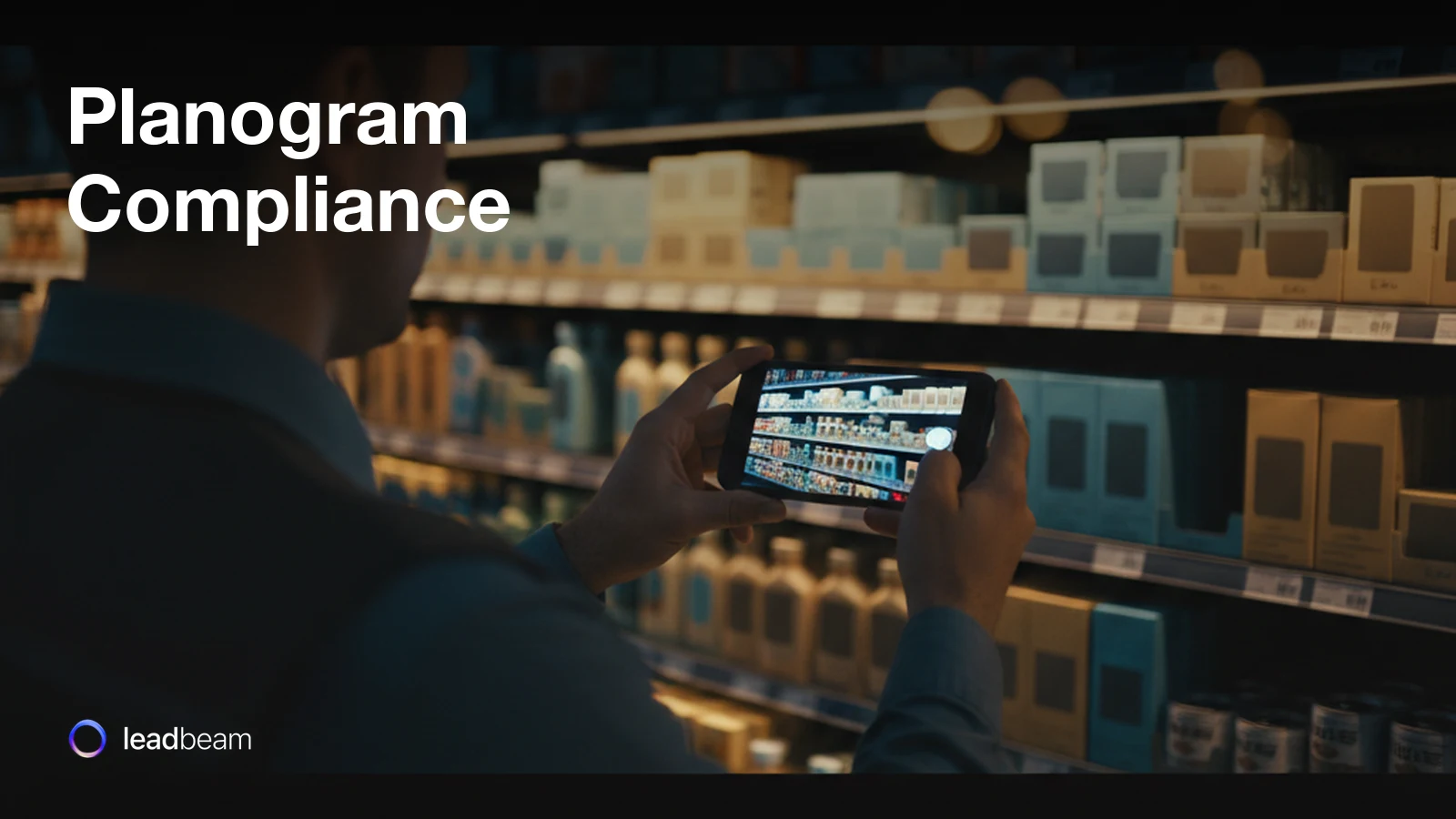
It works like this. The rep photographs the shelf they were going to look at anyway, then the software pulls up that account's planogram, compares the two, and flags problems as concrete actions: move the 12-packs to eye level, the endcap display is missing, the promoted price isn't set. Voids to pitch ride along on the same screen. Photo-based capture on platforms like Leadbeam turns a task reps already do into share-of-shelf and compliance data that headquarters can finally roll up by territory.
That's the rep's real evolution: a shelf-level consultant rather than a box-dropper, able to show a store manager which SKUs to swap to grow the category, backed by data.
Classic route optimization minimizes miles, which is the wrong target. The goal is revenue per day, and the highest-value stop is often not the closest one. Five mid-value accounts sharing a plaza can beat three scattered "priority" doors once you price in the driving between them.
The fix good route optimization tools get right is anchor stops. Key accounts keep their standing day and sequence, and the algorithm optimizes everything around them. You get efficiency where it's free and consistency where it counts.
Reps won't type. A 30-second voice note that lands cleaned and structured in the CRM gets logged, while an evening form does not, the main reason field reps don't log activity in any tool built for a desk. Capture has to happen at the curb, by voice and photo, or the shelf data never shows up.
The market sells this category under one label, but four different kinds of tools answer to the name, and buying the wrong type is the most common expensive mistake here.
Dedicated retail-execution platforms go deepest on the shelf: planogram compliance, image recognition, audit workflows. They're powerful, and usually priced and paced for enterprise with long implementations. If your problem is thousands of stores and complex audits, this is the tool, though it can be heavier than a smaller team will ever use.
ERP and route-accounting suites with a merchandising module bolt a field workflow onto a back-office backbone. They integrate cleanly with the rest of the business, but the field experience is usually an afterthought, and reps quietly abandon the parts that slow them down.
Field-execution and pre-sell layers start from the rep's day instead of the back office. They focus on which door, what to pitch, and what to fix at the shelf, then feed the order and the visit back into whatever system of record you run. They tend to adopt faster because they're built for the field, but they aren't a settlement engine, so you keep your ERP running alongside them.
Image-recognition point tools are excellent at the photo and thin on everything else: routing, scoring, and capture. That's a feature rather than a platform, unless you bolt it onto one.
Most teams end up combining two of these, not buying one box. The mistake is buying a category by its label instead of by the job you need done.
This is the question that saves the most money and gets asked the least.
Most consumer goods operations already run an ERP or route-accounting system that computes a suggested order and closes the books, and that backbone works. The field layer's job is to surface the suggested order at the shelf, let the rep adjust quantities, and push it back through the existing system, not to replace it. Settlement, invoicing, and EDI stay in the back office where finance depends on them.
So the honest boundary is this: the field layer should own the rep's day and the shelf, and feed everything it captures into the systems you already trust. A vendor that insists on being your system of record and your field app on one login is optimizing for their own contract rather than your reps. If you already run a mobile CRM as your system of record, the field layer feeds it rather than fighting it.
Once you know which vendor type fits, the evaluation comes down to a short list. Take these questions into every demo, and make the vendor show you the rep's screen, not the admin console.
Then model the case with your own numbers, and match the tool to your motion. The rep-side of that motion is where selling more into every account happens.
The buying decision for retail execution software comes down to what a platform treats as the main event. Software built around the check-in leaves you with proof a visit happened and little else. Software that treats the shelf as the main event changes what's on it, closing voids and fixing planogram and price while the rep is standing there. None of that shows up in a feature list, only a year later in whether reps still open the app, and that is the number that decides whether the spend was worth it.


Leadbeam Blog
Discover tips, strategies, and success stories to empower your field sales team and drive results.