Smoke Shop POS: The Under-30 ID Rule Is Your Opening Line
Smoke shop POS sales start with compliance, not features. Four questions on age checks, product lists, tax rates and shipping to ask before you demo.

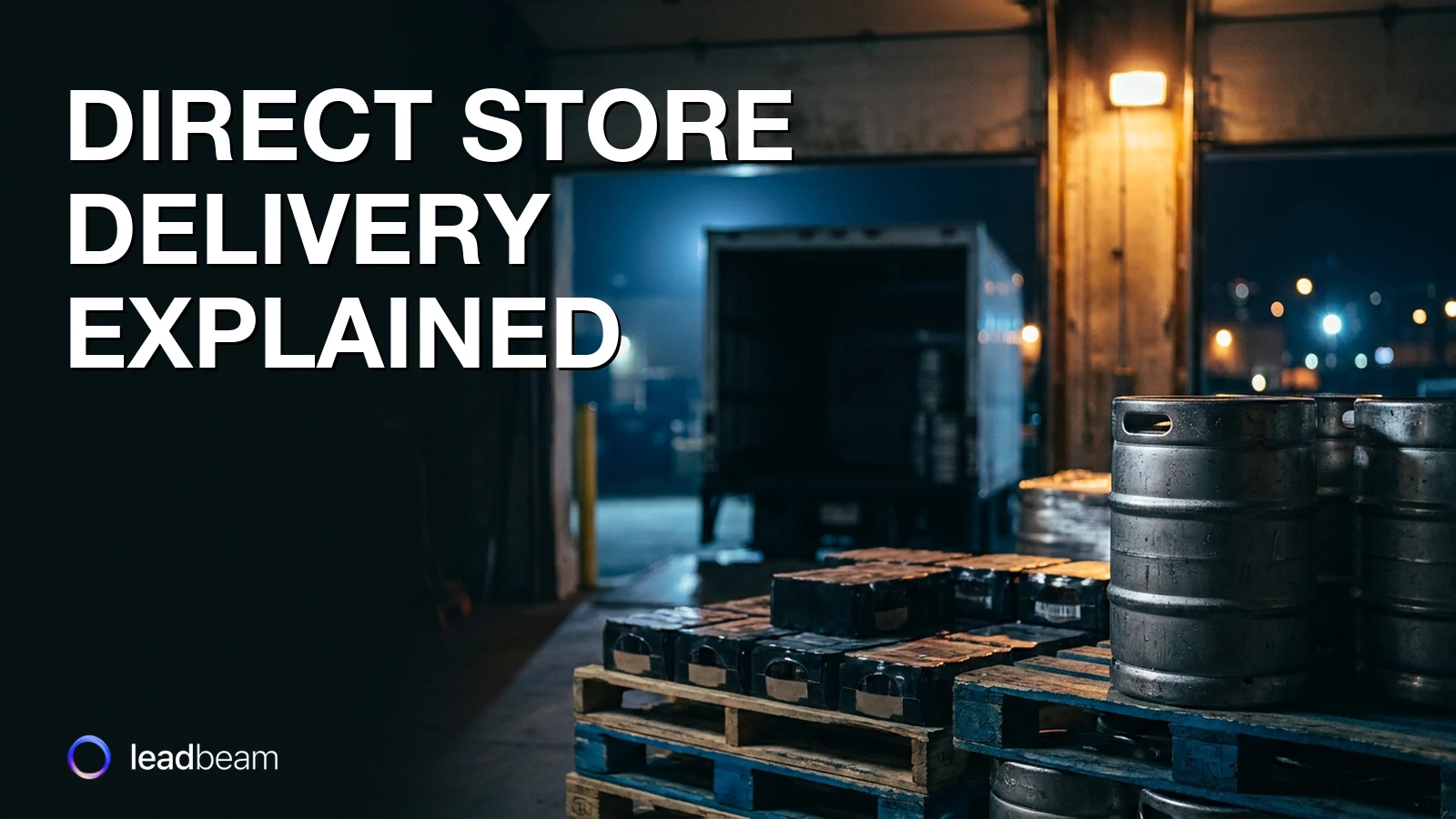
The bread on that shelf got there a specific way.
It didn't come through the grocery chain's warehouse. A driver from the bakery pulled up out back, wheeled it in, stocked the rack, pulled the stale loaves, and left. That's direct store delivery, and it's how a large share of what you buy at a grocery store arrives.
This guide covers what direct store delivery is, who runs it, how it stacks up against warehouse distribution, and why brands pay a premium to keep doing it in 2026.
Direct store delivery (DSD) is a distribution model where the brand delivers its products straight to each retail store, bypassing the retailer's distribution center. The manufacturer's own people, or its distributor's, handle the last mile and often the shelf too.
Compare that to the default. In warehouse distribution, a brand ships a truckload to the retailer's central warehouse, the retailer takes ownership, and the retailer's own logistics move it to each store. The brand's job ends at the loading dock of one building.
DSD moves that finish line. The brand's truck goes to store number one, store number two, and store number three, and a person walks the product to the shelf at each one. That shift changes who does the work, who carries the inventory risk, and who controls how the product looks when a shopper sees it.
The person doing it is a hybrid. A DSD rep delivers, but they also stock shelves, build displays, rotate stock so the oldest sells first, and often write the next order. Part driver, part salesperson, part merchandiser, in one visit.
DSD isn't for everything. It's expensive, so it earns its keep only where the product demands it. Four traits push a category toward direct store delivery.
High velocity. Snacks and soft drinks sell fast and need constant replenishment. A weekly warehouse cycle leaves gaps; a driver in the store twice a week doesn't.
Perishability. Bread, dairy, and fresh tortillas have days, not months. Someone has to pull expired stock and swap in fresh, and that someone is the DSD rep, not a warehouse hundreds of miles away.
Fragility and handling. Eggs, chips, and glass bottles get crushed in a normal warehouse-to-store chain. Fewer touches means less damage.
Merchandising intensity. Categories that live or die on shelf position, displays, and promotions need a person managing that in-store. A warehouse can't build an endcap.
That's why the classic DSD categories are beverages, salty snacks, bread and baked goods, and dairy. Beer and beverage distributors run some of the largest DSD operations in the country. A national salty-snack maker or a large bakery might serve hundreds of thousands of stores through thousands of routes. The scale is real, and it's built on trucks and people, not just software.
Bimbo Bakeries USA, the biggest bakery company in the U.S., runs its bread and pastry business through DSD across 59 bakeries, Zebra Technologies reports. For a product measured in days of freshness, that hands-on control isn't a luxury. It's the model.
Here's the core decision. DSD costs more to run, and sometimes it's worth it.
Warehouse distribution is cheaper per case. The retailer consolidates freight, moves full pallets, and spreads its logistics cost across every brand on the shelf. A brand that goes this route rents that efficient machine and gives up control in exchange.
Direct store delivery flips both. The brand pays for its own trucks, its own drivers, and its own field workforce. Cost-to-serve climbs. What the brand buys with that money is control over three things a warehouse can't touch: when the product arrives, how fresh it is, and how it looks on the shelf.
The math works when on-shelf availability and merchandising drive sales enough to cover the extra cost. An empty shelf is a lost sale that never comes back, and shoppers rarely wait, they grab a competitor. For a high-velocity or perishable category, keeping the shelf full and fresh is the whole business case, and DSD is the way to guarantee it.
The math fails when it doesn't. In 2019, Nestlé USA moved its frozen pizza and ice cream brands off direct store delivery and onto a warehouse model, closing eight frozen distribution centers and dismissing about 4,000 workers, Food Dive reported. Frozen products sit in a freezer for weeks, so the freshness argument that justifies DSD for bread doesn't apply. Nestlé already ran a frozen warehouse network for its other brands, and folding pizza and ice cream into it removed duplicate cost. The lesson runs both ways: DSD is powerful where speed and freshness matter, and dead weight where they don't.
If it costs more, why has direct store delivery survived decade after decade? Because the shelf is where the sale happens, and DSD is the only model that puts the brand's own person there every week.
That presence compounds. The rep sees the store the way the shopper does. They catch the out-of-stock before the manager does. They notice the competitor's new display. They know which of the brand's products the store carries and which it should. That last one is a growth lever most brands leave on the table: authorized products a store has stopped reordering, called voids in the trade. Distribution already exists, so closing a void is close to free revenue, and only a person at the shelf can spot it.
Modern DSD also gets sharper every year as prediction improves. Bimbo Bakeries paired its model with AI-driven forecasting and cut forecast errors by up to 30%, which for a perishable product means less waste and fewer empty shelves at once. The model's oldest weakness, a driver guessing tomorrow's order, is the part software fixes best.
If you run direct store delivery, one choice shapes everything else: pre-sell or driver-sell.
In a driver-sell model, one person does it all in a single stop. They drive the route, sell off the truck, adjust the order at the shelf, invoice it, take payment, and settle up, all from a handheld. It's also called a peddle route. The advantage is simplicity: one visit, one person, order to cash in ten minutes. The cost is that the visit stays transactional, because the same person unloading boxes can't spend an hour talking strategy with the store manager.
In a pre-sell model, the jobs split. A sales rep visits ahead of delivery to build the order and work the account, and a separate driver fulfills it a day or two later. The rep isn't hauling product, so the visit can turn consultative: depletion trends, shelf position, the next promotion, which void to close. The delivery run, meanwhile, just needs proof of delivery and a clean settlement.
Most growing beverage and snack operations are shifting toward pre-sell, because separating the sale from the delivery is what lets the sales visit get smarter. When the rep walks in with the account's order history, its open voids, and its shelf gaps already in hand, the conversation changes. That prep is where a field-execution layer earns its place, and where route planning built around revenue instead of raw distance keeps the pre-sell reps hitting the right doors in the right order. Our guide to route optimization tools goes deeper on sequencing a day for value, and territory management covers dividing the map in the first place.
Direct store delivery runs on more software than a warehouse model, because there's more to track: mobile inventory, in-store activity, and the money changing hands at the curb. Three types of systems show up, and they do different jobs.
Route accounting systems run the money and the movement: mobile invoicing, truck inventory, end-of-day settlement, and tax reporting. This is the financial backbone, the system of record for what left the truck and what came back.
ERP distribution modules bolt a DSD workflow onto a broad enterprise suite. They connect cleanly to the rest of the business, though the field experience is often an afterthought reps quietly route around.
Field-execution layers start from the rep's day instead of the back office: where to go, what to pitch, what to fix at the shelf, and how to capture the visit without an evening of typing. This is the layer that turns a delivery route into a selling motion.
The honest boundary matters here. A field layer doesn't replace the route accounting system. Settlement, invoicing, and truck reconciliation stay where they belong, in the system built for them, and the field layer feeds that system rather than fighting it. Most DSD operations need two of these working together, not one pretending to be all three. The reps who won't touch a clunky settlement screen are the same reps who won't log activity in any tool that wasn't built for the field, which is why the split exists.
Direct store delivery is the model where the brand, not the retailer, owns the last mile and the shelf. It costs more than warehouse distribution, and for high-velocity, perishable, fragile, or merchandising-heavy products, that cost buys the one thing that drives the category: a full, fresh, well-placed shelf, kept that way by a person who shows up every week.
A simple test tells you whether DSD earns its cost in your category. Ask what a store loses when your product runs out or sits a week too long. If the answer is a lost sale that walks to a competitor, or a shelf of stale product a shopper won't touch, the in-store presence pays for itself. If the answer is nothing much, because the product keeps for months and the shopper waits, you're paying for control you don't need. That's the line Nestlé crossed with frozen: a product that sits in a freezer for weeks doesn't reward a person visiting every week, so the warehouse won.
The same logic decides pre-sell versus driver-sell inside a DSD operation. Driver-sell fits when the visit is mostly about restocking and the order barely changes week to week. The moment the account needs a real conversation, about shelf position, new items, a promotion, the driver-sell visit is too crowded to have it, and that's the signal a brand has outgrown the peddle route and should split selling from delivery.
If you're building or scaling a DSD operation, the two questions that shape everything are which categories justify the model and whether you run pre-sell or driver-sell. Get those right, then match the software to the answer. To go deeper on the rep-side motion, start with how to grow beverage accounts in the field or the broader view of FMCG field sales.


Leadbeam Blog
Discover tips, strategies, and success stories to empower your field sales team and drive results.