Retail Store Audit: The 12-Minute Checklist That Pays
A retail store audit should take about 12 minutes and change what the shelf looks like. Here is the walk-order checklist and the method behind it.

Six seconds of silent video. That's all it took.
Researchers showed observers soundless clips of people lasting just six seconds. Those snap judgments predicted real-world effectiveness with a 0.76 correlation. Your prospect has sized you up before you finish your name.
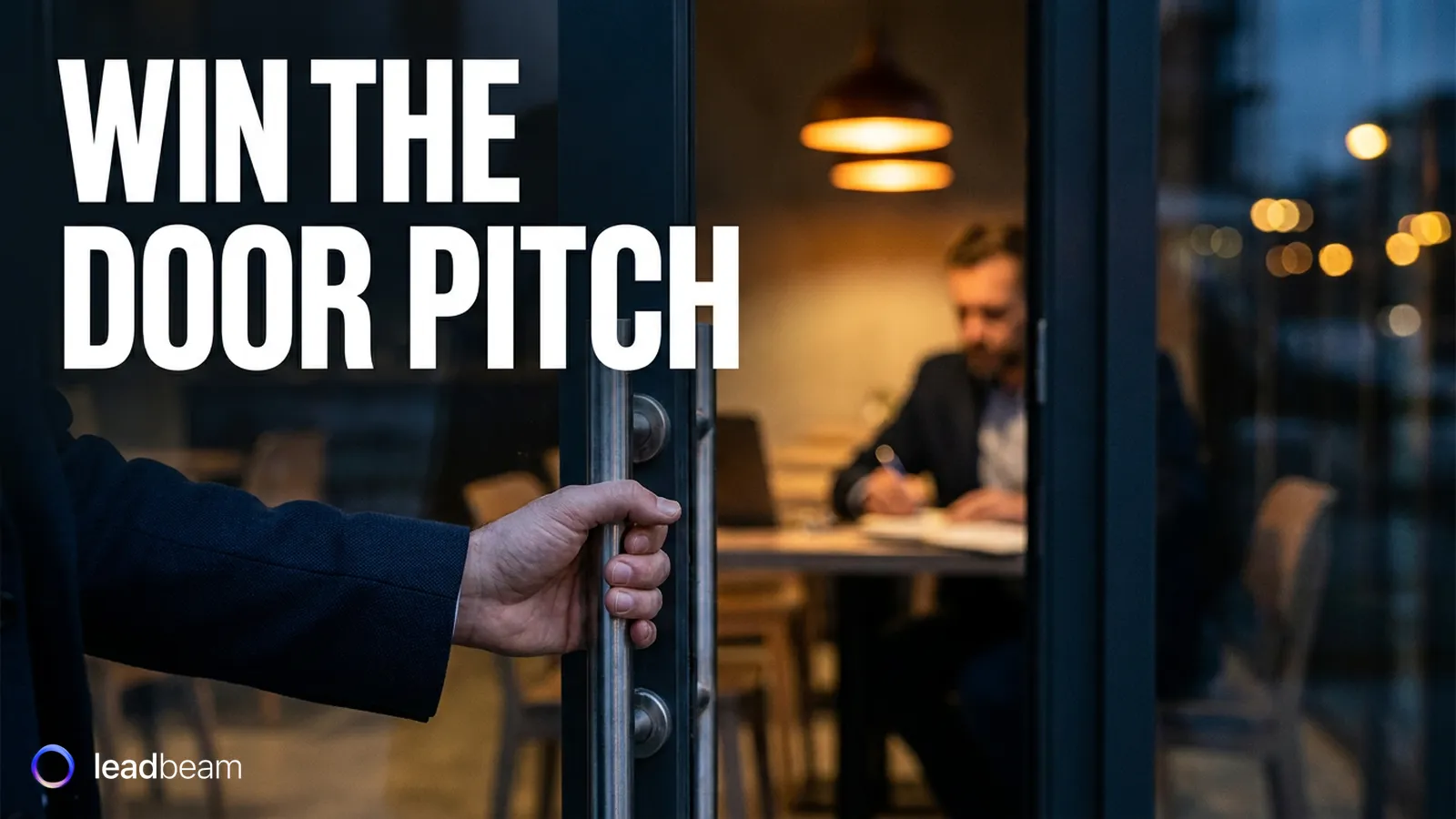
Dana sells restaurant management software across the Midwest. (Name and details changed; this is a composite from conversations with field sales teams.) Last fall, she walked into a barbecue joint in Kansas City at 2:15 on a Tuesday, right between lunch rush and dinner prep. The owner was wiping down a table near the register. Dana had about four seconds of eye contact before the owner said he wasn't buying anything.
Dana didn't pitch. She asked one question: how long does your end-of-day close-out take?
The owner paused. Forty-five minutes on a good night.
That pause was the whole game. Twelve minutes later, Dana had a demo scheduled for Thursday.
She didn't succeed because she had a great script. She succeeded because she interrupted a pattern and asked about a pain point the owner lived with every single night. The data backs up exactly why this approach works.
67% of B2B buyers now prefer a rep-free experience, according to Gartner. They've been through enough irrelevant outreach that shutting down a pitch has become automatic.
Gong's objection analysis confirms it: dismissive responses like not interested, send me an email, and call back later account for 49.5% of all cold call objections. The prospect hasn't evaluated your product. They've recognized the shape of a sales interaction and decided to end it before it starts.
For a rep walking into a business unannounced, that reflex fires even faster. You're a stranger in their space.
The pitch examples below interrupt that reflex.
Gong's analysis of more than 300 million phone calls found one opener that performed 6.6x higher than baseline: How've you been? The dataset is inside-sales, but the mechanism — pattern interruption — applies at the doorstep too.
Three words, no product mention, no company name. They momentarily break the prospect's default rejection script. For a fraction of a second, they wonder whether they know you. That pause buys the next ten seconds.
Most sales trainers dismiss it. The data shows a 10% success rate versus a 1.5% baseline. Adapted for a walk-in:
Hey, how've you been? I'm Dana. I work with a few restaurants on this block. Got 30 seconds?
It won't fit every rep or every situation. But if you haven't tested it, you're leaving the highest-performing opener on the table.
The permission-based opener takes the opposite approach. Instead of implied familiarity, you name the interruption:
I know I'm walking in cold. Can I get 30 seconds to tell you why, and then you decide if it's worth another minute?
This style of opener hits an 11.18% success rate in Gong's data. Nearly 8x baseline.
Giving the prospect an explicit exit lowers their defensive response. Stating the reason for your call boosts success rates by another 2.1x on top of that.
You've earned a minute. Now what?
The PAS framework (Problem, Agitate, Solve) works for quick pitches because it leads with pain. Losing something stings roughly twice as hard as gaining something of equal value, according to prospect theory. That asymmetry is why opening with the problem outperforms opening with benefits.
Here's how it sounds at the door of a restaurant:
Problem (10 seconds): Most restaurant owners I talk to spend 45 minutes on end-of-day close-out because their current system wasn't built for how they run service.
Agitate (15 seconds): Over a year, that adds up to about 250 hours. Six full weeks of an owner's time spent on something that should take three minutes.
Solve (20 seconds): I've set up six spots within a mile of here on a system that handles close-out in under two minutes. I can show you on my phone right now, or I'll leave a one-pager and follow up Thursday.
Three things make this pitch land. First, hyper-local proof: six spots within a mile. Recommendations from people nearby carry more weight than any statistic, as research on social proof consistently shows. Second, the pain is quantified: six full weeks is harder to ignore than saves time. Third, the close offers two options, both low-commitment. The prospect picks between yes now and yes later instead of yes and no.
The framework stays the same, but the pain changes with every vertical.
Medical supply rep walking into an orthopedic clinic:
Building materials rep visiting a general contractor's trailer:
The bones stay the same across every sales motion: acknowledge the cold walk-in, anchor on local proof, name one specific pain, offer two next steps. The goal is always earning the next conversation.
About half the time, the prospect says not interested before you've finished. Gong's research team frames it directly: the "not interested" objection is a reflex, not a reasoned decision.
Here's how Dana handled it when the barbecue owner opened with a brush-off. She didn't argue, didn't reframe, didn't ask another question. She agreed, then left one useful number on the way out: Most barbecue spots I work with shave 35–40 minutes off their close-out. If that's ever worth a look, I'll be back on the block Thursday.
That's the move. Agree with the brush-off so the prospect doesn't feel cornered. Drop one piece of value that benefits them whether or not they ever buy. Set up a low-commitment return that doesn't require their permission. The rep who respects the brush-off and shows up again next week is the one who eventually gets the deal.
The Gong data on phone calls puts winning reps at about a 57% talk ratio across the deal. At the doorstep, talk ratio matters less than capture ratio. SumUp's field reps used to log 7 of every 30-40 daily interactions. After capturing voice notes mid-route, they captured 28. Top reps don't just talk less. They capture more of what the prospect actually said.
At the door, this is straightforward. Deliver your opener, ask one question, and listen. The prospect's answer tells you whether to book a demo or leave a card. Then capture it before you start the car — by the third stop, the details blur.
Dana showed up at the barbecue joint Thursday at 2:00 PM. The owner had already looked up her company. He pointed to the close-out time comparison on the one-pager she'd left.
His manager ran that report every night, he said. If the system did what the one-pager claimed, he wanted to see it.
Fifteen minutes later, they had a pilot scheduled. Dana asked one question on a Tuesday. That question earned 12 minutes on the spot and a signed pilot by the following week.
Here's a challenge for this week: pick the permission-based opener and use it on every walk-in for five days. Track how many conversations get past 30 seconds. That single metric will tell you whether your current pitch earns attention or loses it.
For more on building a walk-in sales motion, structuring in-person conversations, and choosing the right questions to ask once you're past the opener, explore our guides for reps who sell face to face.


Leadbeam Blog
Discover tips, strategies, and success stories to empower your field sales team and drive results.